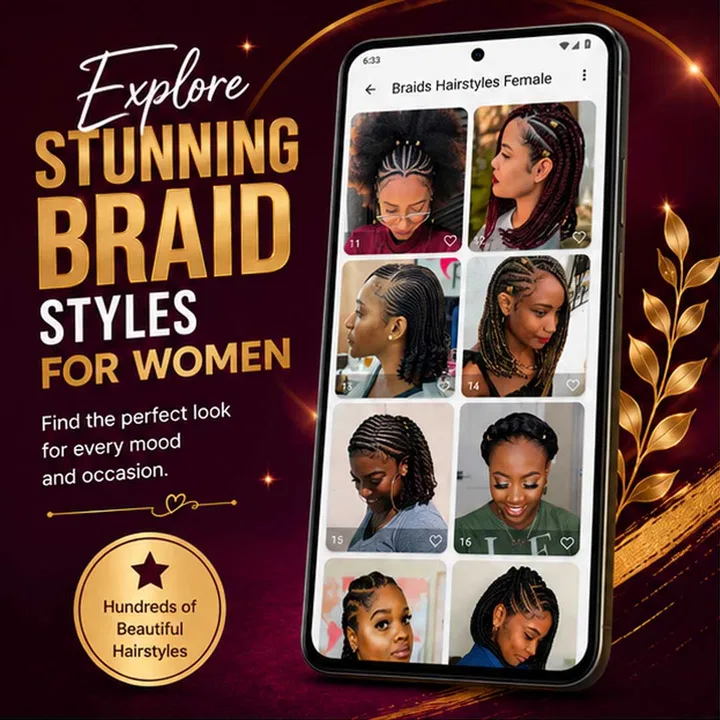
150+ Braids Hairstyles Female
- 4.6
- Rating
- 50.00K
- Installs
- Free
- Price

 Analysis by App-foxy
When I want a quick change to my look, I usually need more than a handful of vague hairstyle ideas. I want to see the braid clearly, understand whether it suits my hair length and texture, and save enough inspiration to explain the result to a stylist. 150+ Braids Hairstyles Female is built around that simple need: browsing braid-focused looks that can be copied, adapted, or used as a starting point for a salon appointment.
After spending time with it, I see it as a visual idea book rather than a full styling course. That distinction matters. The app is useful when you already know you want braids and need help choosing a direction, but it is less suitable if you expect detailed, hands-on lessons for every style. Its strongest quality is the narrow focus on braided hairstyles, which makes browsing more purposeful than searching through a general beauty app.
How I use the app when choosing a braid
My usual workflow starts with a broad look through the available styles. I do not immediately choose the first attractive image because a braid can look very different depending on density, length, parting, accessories, and how closely the finished result follows the reference. I first collect a few candidates, then compare them side by side in my mind: one for everyday wear, one for a more polished occasion, and one that seems realistic for my own hair.
You May Also Like

 Blood Strike: 2.5 Anniversary
Blood Strike’s Loadouts Turn Every Drop Into a Tactical Gamble
A close look at Blood Strike’s custom loadouts: how fast access to signature weapons reshapes its battle royale rhythm, rewards preparation, and narrows the gap between fights.

 Pandora - Music & Podcasts
Pandora’s Music Is Easy to Start, but Harder to Recover
Pandora’s strength is its low-effort path from a seed to a station. Its weak spot is how much confidence it asks you to place in connection, setup, and quiet recovery.

 8 Ball Pool
 Is Built on Rivalries, Rematches, and Routine
A close look at the rivalries, rematches, shared routines, and unanswered safety questions that turn a quick pool match into a persistent mobile community.

 Samsung Music
’s Quiet Strength Is Playing What You Already Own
Its reach comes less from spectacle than from dependable access to a personal library. That simplicity is both the app’s strongest retention engine and its ceiling.

 AccuWeather: Weather Radar
AccuWeather Review: A Quick, Clear Forecast for Everyday Decisions
For everyday plans, the best forecast is the one you can understand quickly. AccuWeather makes rain timing, radar, and local conditions easy to act on, with a few trade-offs.

 Hill Climb Racing
Why Hill Climb Racing Still Turns Crashes Into One More Run
A tiny car, a bumpy hill and one more upgrade: Hill Climb Racing keeps resurfacing because its simple chaos makes every near-miss feel personal.
More From Our News Desk



This approach works well because the app keeps the subject focused. Instead of moving between makeup, skincare, haircuts, and unrelated beauty content, I can concentrate on braids. That makes it especially convenient for someone preparing for a protective style appointment or trying to explain a preferred pattern without relying on hairstyle names alone.
The most useful habit is to treat each image as a design reference, not a promise that the exact result will be effortless. A picture may show a neat finish that depends on professional sectioning or hair extensions. I look at the overall structure first: whether the braids are close to the scalp, loose and flowing, gathered into an updo, or decorated with a more noticeable finish. This helps me avoid choosing a style only because the model’s presentation is attractive.
For an everyday scenario, imagine getting ready for a weekend event with limited time to decide. I would open the app, browse until I found a few looks with a similar level of formality, and then narrow them down according to outfit and maintenance needs. I would take the selected reference to a stylist and ask which version fits my hair. That is where the app adds real value: it shortens the conversation between “I want braids” and a clear visual request.
Turning inspiration into a practical shortlist
I recommend making a small mental or external shortlist instead of endlessly scrolling. Keep one style that looks comfortable for regular wear, one with a stronger visual impact, and one that seems easiest to recreate. This prevents the common problem of saving only elaborate designs and later discovering that none fits your schedule or budget at a salon.
A second useful check is the angle of the reference. A front-facing image may show the hairline and overall shape well, while a side or back view can reveal the parting pattern and how the braids gather. If the app presents a look from only one useful angle, I would use it for inspiration but ask the stylist to adapt the back and sides. That is a sensible limitation of image-based browsing, not a flaw unique to this app.
The app is also helpful for people who know the visual result they want but do not know the technical name. Rather than searching for “feed-in,” “box,” or another specific term and hoping the terminology is correct, I can begin with the appearance. I can then show the image and let a professional identify the technique. This is often more reliable than forcing myself to describe details I do not understand.
Settings and device details worth checking
There are not many choices to configure, which is part of the appeal. I would still check the basic display behavior on the phone I plan to use, especially if I am comparing small details such as braid thickness or the direction of a part. A bright screen and a little zooming can make a meaningful difference when the reference image is being used during a consultation.
The app is free, and it is rated for Everyone, so it is easy to recommend as a low-commitment source of ideas for a broad audience. I would still supervise younger users if they are treating the images as instructions for tight styles. A braid that looks attractive is not automatically comfortable or appropriate for every scalp, and the app should not replace an adult’s judgement about tension, care, or professional advice.
On Android, the app requires version 6.0 or later. That gives it a fairly accessible device range, although the actual browsing experience will naturally depend on screen size and general phone performance. On a larger display, comparing details is more comfortable; on a compact phone, I would avoid making a final decision from a quick glance and instead inspect the image carefully before showing it to someone else.
The current release is version 1.3.12. I see that as a reason to keep the app updated through the normal app-store process, particularly if browsing behavior or image presentation changes over time. I would not build a complicated workflow around a particular button placement. The reliable habit is simply to use the app as a visual catalog and keep any final references somewhere I can access during a salon visit.
Faster browsing patterns that save time
Experienced use is less about tapping quickly and more about deciding what to ignore. I begin by defining the occasion and the maintenance level I can accept. For an ordinary week, I look for a style whose shape appears manageable and not overloaded with decoration. For a celebration, I allow myself to consider more elaborate arrangements. This small decision keeps the browsing session focused.
I also compare styles by silhouette before studying detail. A braid can look impressive in a close image yet create a shape that does not suit the way I normally wear my hair. Looking at the overall outline first helps me identify whether I want volume around the crown, length falling down the back, a compact updo, or a design that frames the face.
Another practical shortcut is to separate “copy exactly” from “borrow one element.” I might like the parting from one look, the gathered finish from another, and the simpler braid pattern from a third. Combining those references gives a stylist a clearer creative brief than sending a large, unfiltered collection of screenshots. It also makes the app more useful for people who want a personalized result rather than a strict duplicate.
For a time-sensitive appointment, I would select a primary reference and a backup with a similar structure. The backup matters because hair length, density, or available extensions may make the first choice unsuitable. Having a second option avoids starting the consultation from zero and turns the app into a preparation tool rather than something I browse only for entertainment.
What the catalog does well for different users
The app is a good fit for someone who already likes braided hairstyles but feels overwhelmed by the number of possible variations. Its beauty category is specific enough to reduce distraction, and the free price makes experimentation easy. A beginner can browse for vocabulary and visual direction, while someone more experienced can use it to refresh a personal collection of ideas before changing their routine.
It is particularly useful for people preparing for a stylist visit. A verbal request such as “something elegant but not too complicated” can be interpreted in many ways. A visual reference gives the stylist a starting point, and the user can then discuss parting, length, extensions, and comfort. The app does not need to solve every technical question to be valuable in that situation.
I also see value for parents or friends helping someone choose a look. Browsing together makes the decision more collaborative. One person can react to the overall shape while another considers practicality. Because the app is free and suitable for Everyone, it is easy to use as a shared inspiration source without asking everyone to create a specialized beauty account or commit to a paid service.
On the other hand, I would not choose it as my main tool if I needed detailed tutorials, timing guidance, product recommendations, or advice tailored to a particular scalp condition. A visual catalog can show the destination, but it does not necessarily teach the route. Someone learning to braid from scratch may be better served by a dedicated video-learning platform or a stylist who can demonstrate hand placement and tension in real time.
Important limits before copying a style
The biggest limitation is the gap between seeing a finished hairstyle and reproducing it. A reference image does not tell me how long the appointment will take, how much preparation is required, whether extensions are involved, or how the style will feel after several hours. I would never assume that a complicated pattern is suitable simply because it looks neat in the app.
Hair texture and density also change the result. The same braid design may appear fuller, flatter, tighter, or more delicate on different hair. Rather than rejecting a style because my hair does not match the reference, I would ask a stylist how to adapt the scale and tension. But I would also accept that some looks are better treated as inspiration than as exact targets.
Comfort should be part of the selection process. Very tight braids, heavy additions, or excessive length may not work for everyone. If a style creates discomfort, headaches, or noticeable pulling, a visually similar but looser arrangement is the better choice. The app can help me identify the appearance I like; it cannot assess how my scalp will respond.
There is also a risk of spending too long browsing without making a decision. Because the subject is visually appealing, it is easy to collect more ideas than a stylist can reasonably compare. My solution is to stop once I have a clear favorite, a practical alternative, and a note about what I like in each. That turns inspiration into an actionable plan.
How it compares with broader beauty alternatives
Compared with a general beauty app, this one feels more direct because I do not have to filter out unrelated content. A broad platform may offer stronger community discussion, tutorials, product links, or personalized recommendations, but it can also make it harder to find a specific braid idea quickly. I would choose the broader option when I need education or conversation; I would choose this app when I already know the category and want visual variety.
Compared with social media searches, the experience is less dependent on following creators or sorting through trends. Social platforms can provide more context, comments, and videos, yet they also mix professional results with heavily edited images and unrelated posts. This focused app is calmer for a short decision-making session, although social media may be better when I want to see a style moving, being installed, or maintained over time.
Compared with a tutorial app, its role is different rather than directly superior. Tutorial services are better for learning sequence and technique. This app is better at the first stage: deciding what I want to learn or request. In my workflow, I would use the braid catalog to choose a target and another resource, or a professional, to understand how that target should be created safely.
My experience with its place in a beauty routine
The app has built a respectable audience, with an average rating of 4.6 from around 1.3 thousand ratings and more than 50 thousand installs. Those figures suggest that the focused concept is resonating with people looking for braid inspiration, but I would still judge it by my own needs rather than treating popularity as proof that every image will suit me.
FOREFO keeps the product positioned as a straightforward beauty app rather than an all-purpose styling platform. I appreciate that clarity. The experience does not ask me to learn a complex system before I can get value from it. I can open it before an appointment, browse for a few minutes, and leave with a visual direction.
The trade-off is depth. If I want a complete routine covering preparation, installation, nighttime protection, washing, takedown, and aftercare, I need additional guidance. That is not a reason to dismiss the app; it simply defines the right stage for using it. It works best near the beginning of a hairstyle decision, not as the only source of expertise from consultation through maintenance.
Because it is free, I can also use it experimentally. I might browse styles I would not normally consider, then identify a toned-down version that fits my daily life. This is one of its quieter strengths: it expands the range of ideas without forcing me to purchase anything before I know what I like.
Who should install it and who should skip it
I would recommend it to anyone who wants braid-specific inspiration, especially before a salon visit, a special occasion, or a personal style change. It is also a sensible choice for users who dislike searching through broad beauty feeds and prefer a compact visual starting point. The free access makes it easy to test without turning the decision into a financial commitment.
I would skip it as a primary tool if my main goal were mastering braiding technique at home. I would also look elsewhere if I needed highly personalized recommendations based on hair history, scalp sensitivity, or a precise maintenance schedule. In those cases, a qualified stylist or a learning-focused resource will provide more useful answers than finished images alone.
For everyone else, the best expectation is simple: use it to choose, compare, and communicate. Do not treat every reference as a step-by-step promise. Save time by narrowing the options, ask practical questions before installation, and let the final style be adapted to your own hair rather than forcing an exact imitation.
My final verdict after using it
150+ Braids Hairstyles Female succeeds because it understands a specific moment in the beauty process: the moment when I want a braid but need to see which braid. Its focused catalog, free access, broad age rating, and accessible Android requirement make it an easy recommendation for visual discovery. The app is most useful when I approach it with a plan and use the images as conversation starters.
My strongest tip is to combine three habits: decide the occasion first, compare silhouettes before details, and bring one realistic backup to the stylist. That workflow exposes the app’s real strength while reducing its main weakness, which is the lack of technical context behind a finished image.
It will not replace a tutorial, a consultation, or personal judgement about comfort. It does not need to. As a focused beauty reference from FOREFO, it gives me a practical way to turn a vague wish for “new braids” into a shortlist I can actually discuss and adapt. If that is the decision I am trying to make, I would keep it on my phone.
FAQs for 150+ Braids Hairstyles Female
01What features does the 150+ Braids Hairstyles Female app offer?
The 150+ Braids Hairstyles Female app provides a comprehensive collection of braid styles, including step-by-step tutorials, hairstyle galleries, and tips for maintaining healthy hair. Users can browse through various categories, bookmark their favorites, and even access video tutorials for more complex styles. The app is designed to inspire and simplify the hairstyling process for all skill levels.
02Is the app suitable for beginners in hairstyling?
Yes, the app is beginner-friendly. It includes detailed tutorials with easy-to-follow instructions and visual aids, making it accessible for those new to braiding. Each style is rated by difficulty level, so beginners can start with simpler designs and gradually progress to more intricate braids as they gain confidence and skill.
03Does the app require an internet connection to use?
The 150+ Braids Hairstyles Female app can be used offline for most features, such as accessing saved hairstyles and tutorials. However, some features, like video tutorials and updates to the hairstyle gallery, require an internet connection. This allows users to access the latest content and trends in braiding whenever they have connectivity.
04Are there any in-app purchases or ads in the app?
The app offers a free version with access to a selection of hairstyles and tutorials, supported by ads. For an ad-free experience and access to exclusive content, users can opt for in-app purchases or a subscription model. This premium option offers additional features, like personalized hairstyle recommendations and advanced tutorials.
05How frequently is new content added to the app?
The app is regularly updated with new hairstyles and tutorials to keep up with the latest trends. Users can expect fresh content every month, ensuring they have access to the newest styles and techniques. This commitment to regular updates helps users stay inspired and expand their hairstyling repertoire consistently.
Pros
- Wide variety of styles available.
- Easy-to-follow tutorials included.
- High-quality images for inspiration.
- Regular updates with new styles.
- User-friendly interface for navigation.
Cons
- Limited offline access to content.
- Some styles require in-app purchases.
- Ads can be slightly intrusive.
- No option for user style submissions.
- Requires stable internet for best use.

150+ Braids Hairstyles Female
Gallery